
By Damian Mathews & The Last Mile Team
Ask a stranger to name an AI company and you’ll get one answer. ChatGPT. Over a billion people use it every month. It’s a verb now, the Kleenex of artificial intelligence.
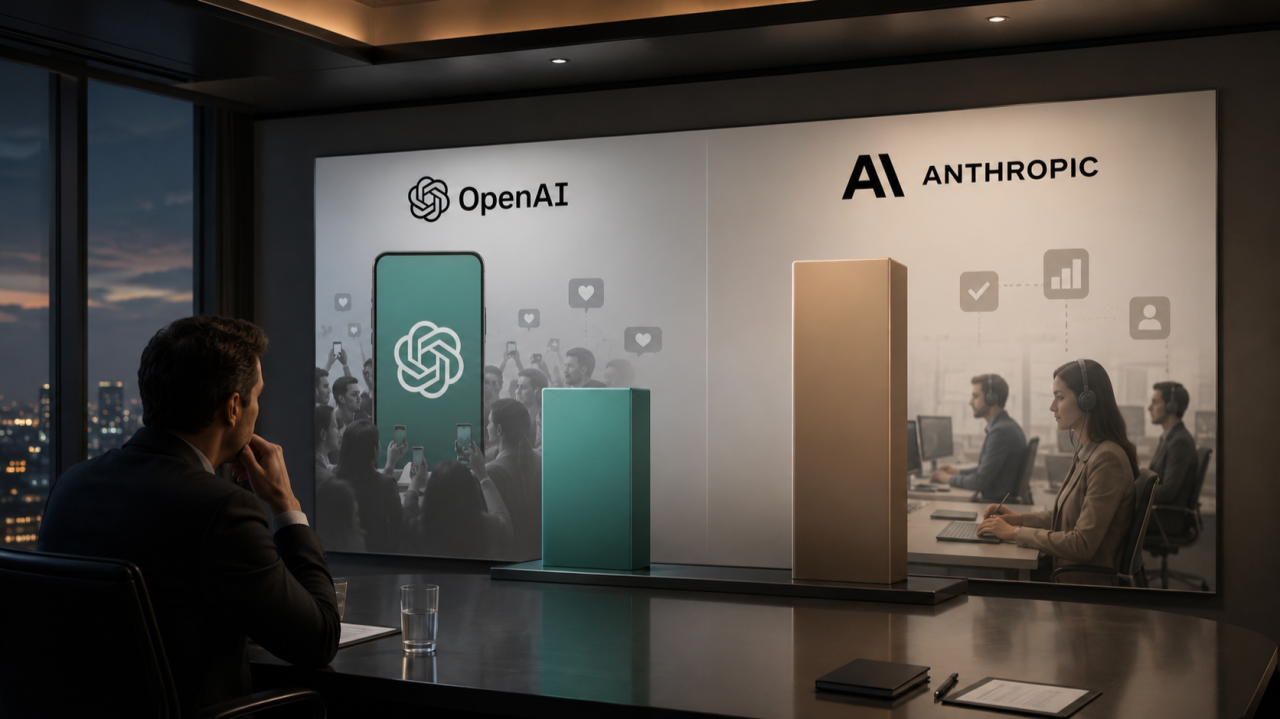
Which is what makes last week’s news so strange. Anthropic, the AI company many people outside the industry couldn’t name, has passed OpenAI in revenue. Anthropic is running at $47 billion a year. OpenAI’s own most recent disclosure puts it between $25 and $33 billion.
And the climb was steep. Anthropic’s revenue was around $10 billion a year ago. It nearly quintupled in twelve months, without a household name to lean on.
How does the company nobody’s heard of outearn the most famous product on the internet? Look at who’s paying. OpenAI’s revenue comes overwhelmingly from consumers subscribing to ChatGPT. Anthropic’s comes overwhelmingly from businesses paying for work: customer service, coding, document analysis. One gets talked about at dinner parties. The other gets built into operations.
Fame and value, it turns out, are keeping different scoreboards.
I’m sharing this because of a question I know many of you have fielded, usually from a board member or a CEO holding their phone. “Shouldn’t we just go with the AI everyone’s heard of?”
It’s a reasonable question. Familiar feels safe. Nobody gets fired for picking the name everyone knows. But this week’s numbers show why it’s the wrong test.
Fish wrote about this exact confusion in Heisenberg’s Trough. His point was that the hype cycle everyone quotes is a sentiment model. It tracks how people feel about a technology, and tells you almost nothing about where value is being created. Brand recognition is the same kind of reading. It measures feelings, at scale, and feelings are exactly what a billion casual users generate.
Fish called confusing a dip in sentiment with a dip in value a strategic error. The same error runs in reverse. Confusing a peak in fame with a peak in fit is how companies end up choosing their most important technology the way they’d choose a soda.
To be clear, none of this means you should switch logos and pick the new leader instead. That’s the same mistake wearing a different jersey. Leaderboards flip monthly. A few weeks ago we watched the best model in the world go offline with three days’ notice. The top spot is a lease, never a deed.
The better test is the one the winners keep using. The plumbing companies we wrote about in A Plumber’s AI Just Hit $1 Billion never asked which AI was most famous. They asked which one answered the phone at 3am and booked the job. The organizations in The 20% Club capture most of AI’s value the same way, by pointing it at their own work and measuring what happens.
It’s also how we chose our own tools. Every pick documented in A1B: Customer Zero to AI-First came from testing against our actual jobs, with the full expectation that the answer would change as the models did.
For a contact center, that test is surprisingly small. Take your top three contact reasons, run real conversations through the candidates, and measure which one resolves them. That’s a couple of weeks of work. It’s also the cheapest de-risking move on the table. Two weeks of testing against a decision that sets your cost-to-serve for years is a rounding error next to the cost of guessing wrong.
The famous name may keep changing. The test almost certainly doesn’t.
If your board asked tomorrow why you chose your AI, would the answer be a brand or your own evidence?
— Damian
Here’s what went down this week.
Bleeding Edge
Early signals you should keep on your radar.
India’s BPO sector just got a number put on the shift everyone felt coming. India’s own government think tank, NITI Aayog, projects that in a worst-case scenario the country’s customer-service headcount could fall from 2–2.5 million in 2023 to 1.8 million by the end of the decade — even as sector revenue keeps climbing. Read the two lines together and the story isn’t “BPO is dying.” It’s that the seats are what’s disappearing, not the work. AI is absorbing the high-volume, repeatable tasks that labor arbitrage was built to move somewhere cheap, and what’s left for humans is the supervision, the governance, and the performance layer on top. NITI Aayog says the quiet part out loud: whether the industry ends up a net employer or a net loser “depends on the actions we take.” That’s a different business than the one being automated away, and the providers who come out ahead are the ones building that layer now, not the ones still selling seats by the thousand.
The “action gap” in agentic AI now has a hard number from a source boards trust. Gartner predicts over 40% of agentic AI projects will be canceled by the end of 2027, and the three causes it names are escalating costs, unclear business value, and inadequate risk controls. Notice what’s missing: model capability. The gap isn’t really the AI… it’s more that most deployments never got pointed at a measured outcome, which is the whole argument for testing on your own traffic before you buy, not after.
Leading Edge
Proven moves you can copy today.
Capital One rebuilt its contact center on a modern cloud platform and had it in production in months — training agents in about 30 minutes each and hitting full adoption in five. Worth remembering how: they did it with an in-house engineering org thousands strong, the kind that spins its own tooling into a product line. The platform migration is genuinely that fast now. The real question, for everyone who isn’t secretly a technology company, is who builds and runs the layer Capital One built for itself.
The most rigorous study we have on agent-assist AI landed a clear number. Across 5,179 support agents, a generative assistant lifted issues resolved per hour by 14% on average, but newer and lower-skilled agents jumped 34–35% while veterans barely moved. That tracks with the shift above: the simple contacts are going to automation, and on the harder ones that are left, the assist works as a coaching multiplier for the people still learning the ropes. Point it at your ramp and your bottom quartile, not evenly across the floor, and the return shows up faster.
Off the Ledge
Hype and headaches we’re steering clear of.
After-call work is going up at most contact centers that deployed AI, and that’s not the failure it looks like. A CX Today workforce analysis this spring found 73% of leaders said after-call work stayed flat or rose after deployment. Here’s the trap: when AI absorbs the simple contacts, humans are left with only the hard ones, so their handle times climb. The AI is doing its job. But if nobody re-baselined the metrics, the dashboard now shows your agents “getting worse” while the operation is actually improving. The lesson here is likely that “we bought the AI” and “our metrics still mean what we think they mean” are two different sentences.
Voice cloning went from party trick to board risk. Pindrop, analyzing over 1.2 billion calls, found deepfake fraud attempts rose more than 1,300% in 2024; from about one a month to seven a day with fraud attempts in US contact centers now landing roughly every 46 seconds. The uncomfortable part: the same conversational AI making self-service better is also lowering the cost of impersonating your customers. So, identity verification stops being an IT checkbox and becomes part of the CX design itself.