
Richard R. Waterfield Speaks at Columbia Business School
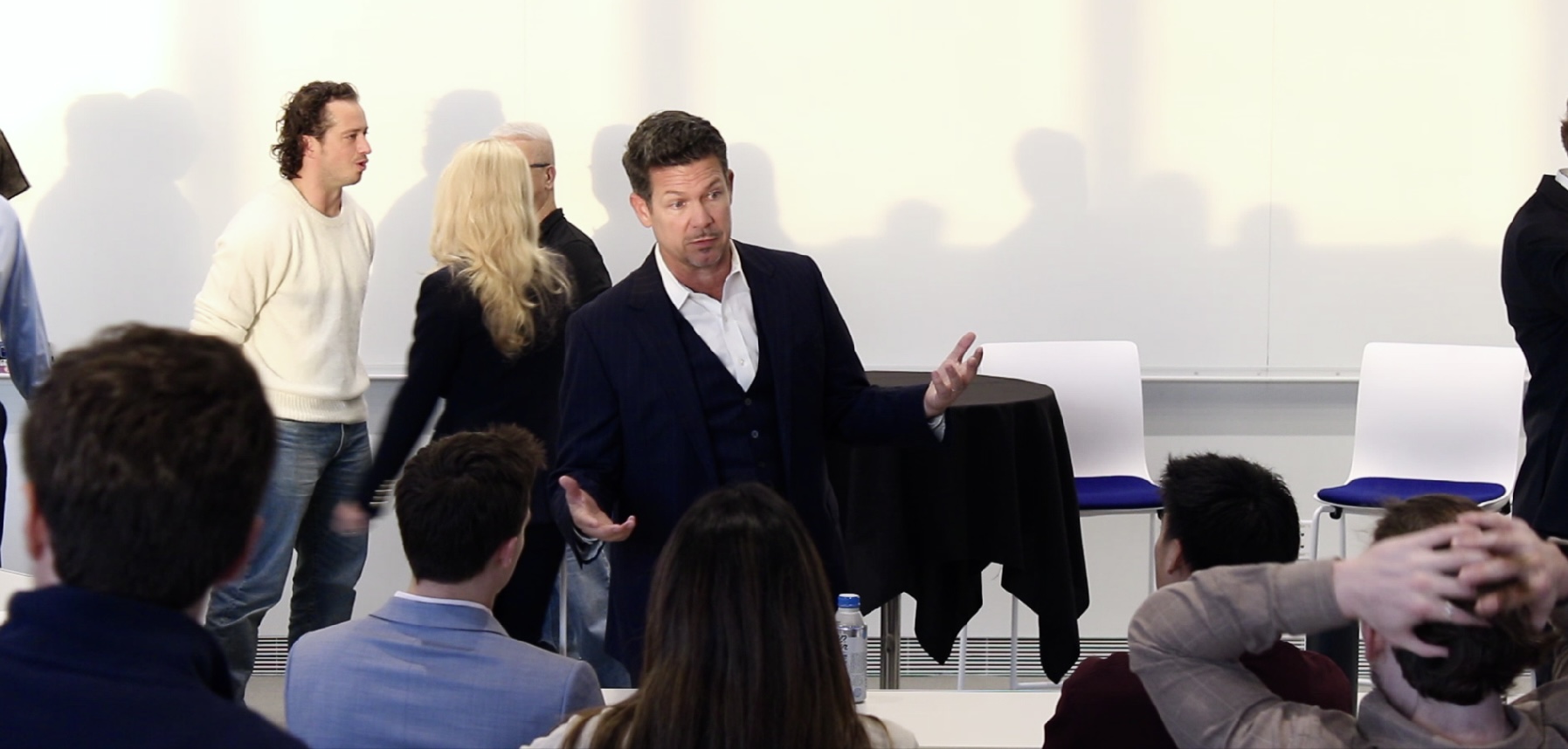
Richard R. Waterfield, co-chairman and CEO of Waterfield Enterprises, returned to Columbia University for a panel discussion exploring the relationship between faith, finance and human flourishing. A 1994 Columbia economics graduate, Waterfield drew on his Indiana upbringing and career in finance and business leadership to discuss why integrity, purpose and personal conviction matter alongside professional achievement. Read the transcript below:
1. Personal Faith and Arriving at Columbia
CONTEXT: The panelists are asked about their personal faith journeys.
RICHARD WATERFIELD:
Well, it’s wonderful to see you all here, and it’s wonderful to see a group like this at Columbia. I think I was talking to one of you about when I was in Columbia, it felt like God had left the building.
So, I was here 1992 to 1994, and it sort of speaks to my spiritual journey. Growing up in Indiana, I took it for granted that everybody was Christian, and everybody I knew was Christian. Everybody went to church. It was wonderful.
I’ve said many times it was a real source of strength, in good times, bad times, and kept the family together. It helped me when I had difficult times in grade school, high school. [Unclear.] As I’ve gotten older, I try to turn to God when I’m having successes instead of just asking.
Of course, when I got to Columbia, it was just like Indiana boy in New York City, right? I just felt like a fish out of water. I was scared to death. A couple of the guys that I met here were Christian, and that was a nice bond for us. But we were clearly expected to kind of be underground.
I think some of that’s changing in Columbia, even at the highest levels. My daughter’s here now, and so I had a bunch of discussions with administrators. And I think they’re trying. So that’s a positive.
I think the big one is that when I’ve had real tragedy or real difficulty – one of my favorite sayings is, “There’s no atheists in foxholes.” In the financial crisis in 2010, I went from very wealthy to having a negative net worth. And it scared the crap out of me. It was just another one of those times where I turned to God, and it gave me strength.
The way I describe it is, a lot of times I’ve looked behind me, and it was just one set of footprints. And that’s it. It’s a source of strength.
My wife’s Catholic. My kids are growing up with it. My daughter is a sophomore here. So, yes, work in progress.
2. Business, Character, and Human Flourishing
CONTEXT: The discussion turns to Richard’s family business and the relationship between his professional journey and his values.
RICHARD WATERFIELD:
I can’t resist the human flourishing concept. My story, my success story, really started with Goldman Sachs. When you get inside the hallowed halls of Goldman, it’s a lot different than what the press makes it out to be.
I found myself surrounded by mentors, and one of my mentors was the chairman. And I think they choose you. They are very conscious about the decisions they make. I don’t know if any of you have been through a [Goldman] interview cycle, but they interview 15 times. Everyone has to say yes.
Keep in mind that the Ivy League is a 4% acceptance rate. All the applicants at Goldman are Ivy League people, and there’s a 2% acceptance rate. So, it’s just a really, really rigorous process. […] My boss at Goldman, my direct boss, ended up being the lead independent director of the hedge fund that I started. He was number one in his class at Harvard Business School, and then number one in his class at Yale Law School. [Unclear passage]
There’s no chance you’re going to be the smartest guy at this place. I wasn’t the smartest guy. What I think was different about me, what I sensed, is that I have a moral compass. When you’re coming from a Christian background, when you’re coming from the Midwest, I think that moral compass is really attractive.
I’ve always felt like capitalism is — there’s two kinds of capitalists, right? There’s zero-sum-game capitalists, and they feel like the only way they win is if they take your money.
And then there’s real capitalists who understand that one plus one equals three. I have a cow, you have a chicken. I’ll give you some milk; you give me some eggs. One plus one equals three.
So, if you have that mentality, at the very highest echelon on Wall Street, they understand that that mentality is what makes you successful. It’s what makes the world tick.
And these guys — 15 years I was [at Goldman] watching these guys — when they make three, four, five hundred million, in today’s dollars it’s a billion dollars, they all retire, move to the country, and buy a ranch.
They all start getting simple because they’re really smart people who understand that success is about a lot more than just money.
[Part of a discussion of leadership and happiness research is unclear.]
Well, there’s several things. It’s money — money’s in there — but it’s faith, it’s fun, it’s family. These are the fabric of what makes you actually successful. And when people sense that, they want to do what you’re doing.
Our hedge fund, Goldman started us out with $8 million, which at the time was a lot of money. But we hit a billion in 2000. And I would venture to say, in retrospect, all of that money was raised on who we were.
So, it was really who we were, who they thought we’d become, how we’d deal with adversity, and how we’d deal with those questions that you get, which are, “Are you going to cheat?”
Short term, the cheaters kind of – . Long term, they wash out. Wealth is a long-term game, and you do better if you’re one of the good guys.
I think there were 100 kids in my class, and the head of compliance calls to me. He brings me to his office. He says, “I need to talk to you. What’s this pretrial diversion that you had as a sophomore in high school?”
He found a record that had been expunged, where I got pulled over — I did all the work, the community service, and it was supposed to be expunged. And they found it.
And he said, “I need to know that you’re a good guy. What happened here?” I guess my point is they’re vetting who you are at the high level, and you’re never going to be the smartest guy. You’re also, by the way, never the richest guy around there.
It’s about who you are. The lesson of my life, which is very much grounded from Christianity. And of course, Gene [name unclear] was Christian. He was my mentor for 15 years.
3. Ethical Boundaries and Reputation
CONTEXT: An audience member asks whether Richard’s comments about long-term integrity also apply to technology projects with potentially harmful consequences.
RICHARD WATERFIELD:
That’s a great question. We’re in AI. One of our major investments is AI, and this question keeps me up at night.
If people like you and I don’t draw a line on things, who’s going to draw a line?
If I was convinced that AI was going to destroy humanity, we would get out of it. Our current opinion is that we can figure out how to keep control of it. We can separate evil AI from good AI.
But I think the real answer to your question is, at some point, you have to decide what you stand for. And in my experience, when you take those stands, you get rewarded for taking them.
The most substantive people in the world take those stands, so they respect [unclear]. And if you’re kind of greasy, and you’re making decisions that are all about making money, and you’re hurting other people, smart people figure that out.
Goldman used to have this internal saying: “It takes years to build a reputation, and it takes a month to lose a reputation.” There’s an economics to integrity.
You’ve got to decide what the right thing is, take the stand, and be confident that long term you’ll be rewarded.
4. Holding to Personal Convictions at Columbia
CONTEXT: An audience member from Michigan asks about maintaining faith in environments where it is not shared by everyone, and about moments when Richard had to prioritize his beliefs.
RICHARD WATERFIELD:
What comes to mind when I’m hearing your question is – I was talking to somebody about it before the presentation. Columbia has an interesting effect on a student’s faith if you decide to approach it this way. It battle-tests it.
At Columbia, I had to defend who I was all the time. And you get stronger when you’re doing that. You get more confident, and over time you start to see other people kind of come your way.
[Unclear passage.] Columbia needs this so badly. It’s just drifting. But I think the fact that you’re here, and that they know they’ve drifted is apparent. That’s how I would approach it: it’ll make you stronger if you’re thoughtful about it.
You can’t hammer people in a place like Columbia on, “You need to become a person of faith.” But what you can do is be sensible and thoughtful and not back down.
And I think you’ll find that a lot of people come from places other than Michigan, and so they haven’t had any exposure at all.
You can either look at it like everything’s an opportunity or everything’s wrong. At Columbia, there’s an amazing opportunity [unclear] to enjoy. I would do that.
5. Columbia’s Direction
CONTEXT: An audience member asks what Richard can share about conversations with Columbia administrators before his daughter enrolled, including whether they recognized a need to reconsider the university’s direction.
RICHARD WATERFIELD:
I did have those discussions where I said, “We’re not interested if it’s too far gone.”
And I can tell you some of the highest-level people at Columbia are aware of the fact that there’s been too much drift away from core American values. You don’t have to call it necessarily Christianity. It’s also patriotism, meritocracy, family.
I think that there’s a sense that Columbia could become the most balanced Ivy League school, and it wouldn’t have to give up anything. All we’d have to do is stop indoctrinating or stop pulling so far in one direction. Get back to education. There’s an opportunity here for that.
I’ve said many times — people ask me all the time, “How did you let your daughter go to Columbia?” I’ve got these Republican friends, and they’re just like, “What are you thinking?”
And I said, “Look, I’m not ready to give up. I believe this is a beacon. It’s the ivory tower. It’s the best we’ve got.”
So, people in this room, you can really make a difference here if you just kind of move a little bit back towards the center. It has to be done gradually. You can’t be too extreme.
But that’s a real opportunity. And I think there’s an openness to it at the highest levels because they know they’re doing something wrong.
6. Career Reflections, Risk, and Resilience
CONTEXT: In the closing discussion, the panelists reflect on what they would change about their careers. A brief exchange leads into Richard’s comments about the independence he had at Goldman.
RICHARD WATERFIELD:
I wouldn’t change a lot of the way I handled things. […] I was very happy. They gave me a lot of independence. They created a situation where I was almost my own boss, because the hedge fund world was evolving — the hedge fund [unclear] got interesting.
Most people don’t realize it, but originally there were little hedge funds in all of the Wall Street firms. Goldman had a desk full of people that got basically “zero-fifty.” Then some of these guys started saying, “Well, what if I took that desk out?”
Mark Kingdon was a Columbia guy I used to cover. He took it out and said, “Hey, let’s make a fund called a hedge fund. I will take two-and-twenty instead of zero-fifty.”
Yeah, I really loved my career. Would I be a little less risky? I think earlier on we were quite too open to risk.
I’m a big Buffett fan. Warren Buffet. I think he proves something that we don’t learn at business school, which is that you probably do better if you have a lower risk profile.
I’m not sure I really believe that ultra-risk creates ultra-return, except in a few instances like Musk. I think in the real world I would have been a little bit more conservative, because it would have taken the volatility out of the [unclear].
But when you get hit with a 2000 financial crisis, you’re really happy if you’re conservative. And if you’re the last guy standing in a global financial crisis, in our experience that’s been the best, because you have a little dry powder. You come out of it stronger.
Yeah, that’s the only thing I would change.
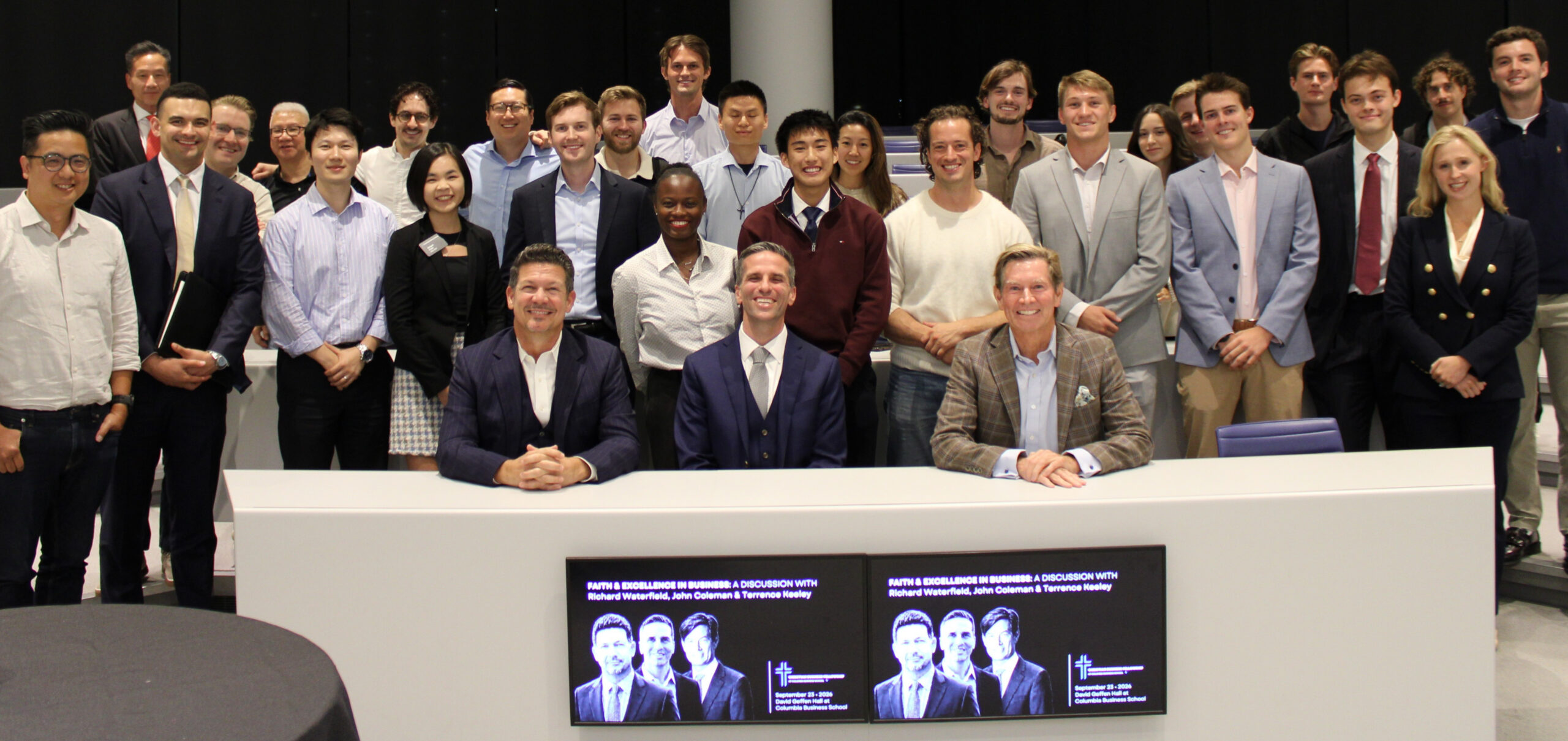
For students preparing to begin their own careers, Waterfield’s return to Columbia offered a perspective shaped by both achievement and adversity: professional ambition and personal conviction need not compete. Richard’s message encouraged students to pursue success while remaining grounded in character, relationships, and a commitment to faith.